viernes, 26 de noviembre de 2010

miércoles, 24 de noviembre de 2010
LIVES THAT CHANGED OUR WORLD EXAMPLES OF INSPIRATIONAL PEOPLE
In this session we are going to have a look at the lives of some people that tried to improve their lives and the lives of the people in their communities and societies as they could not accept that people’s rights were being denied. We are going to focus on 3 men: MARTIN LUTHER KING, NELSON MANDELA and MOHANDAS GANDHI. But we should also mention the names of other people that wanted to change some aspects of the world like Mother Theresa, John Lennon, Dalai Lama, Rigoberta Menchú, etc.
 Martin Luther King (Atlanta USA 15 January 1929)
6 decades ago, in the southern USA, a young black boy called Martin Luther King was growing up. Martin saw how badly black Americans were treated by white Americans. Blacks could not attend the same schools, eat in the same restaurants or travel on the same buses as whites.
All over the south, Martin Luther King led peaceful protests, calling for equal rights for black people. In 1963 he led thousands of people, both black and white, on a march to Washington, the capital of the USA. In a speech he said: “Ï have a dream, that my four little children will be judged not by the colour of their skin, but by the content of their character”.

Nelson Mandela (Umtata, South-Africa, 18 July 1918)

Mohandas Ghandi (Porbandar India, 2 October 1869)

Mother Theresa (India, 26 August 1910)

Jhon Lenon (Liverpool, England, 9 October 1940)

Dalai Lama (Taktser, Qinghai, China 1935)

Rigoberta Menchu (Chimel, Guatemala 1959)

http://www.biographyonline.net/people/women-who-changed-world.html
 Martin Luther King (Atlanta USA 15 January 1929)
6 decades ago, in the southern USA, a young black boy called Martin Luther King was growing up. Martin saw how badly black Americans were treated by white Americans. Blacks could not attend the same schools, eat in the same restaurants or travel on the same buses as whites.
All over the south, Martin Luther King led peaceful protests, calling for equal rights for black people. In 1963 he led thousands of people, both black and white, on a march to Washington, the capital of the USA. In a speech he said: “Ï have a dream, that my four little children will be judged not by the colour of their skin, but by the content of their character”.
Martin Luther King had many enemies. In 1968 he was shot and killed by a white man. Although life for many black Americans has improved, they have still not gained complete equality, for which Martin Luther King fought so hard.

Nelson Mandela (Umtata, South-Africa, 18 July 1918)

Mohandas Ghandi (Porbandar India, 2 October 1869)

Mother Theresa (India, 26 August 1910)

Jhon Lenon (Liverpool, England, 9 October 1940)

Dalai Lama (Taktser, Qinghai, China 1935)

Rigoberta Menchu (Chimel, Guatemala 1959)
- Luther King, Mandela and Gandhi took action in different ways because they saw some human rights were being denied to some groups of people. Describe the denial of human rights in their 3 cases. Martin Luther King: Black Americans were badly treated by White Americans. Nelson Mandela: protested against the new “apartheid” laws in South Africa, which separated people because of the colour of their skin. Mohandas Ghandi:There were terrible fights between Hindu and Maslem people.
- How did they protest against what they thought was not right? (marches, demonstrations, etc) They protested pecefully.
- Did any of them go to prison? If so, how long were they there? Nelson Mandela was in prision for 28 years and Gandhi stayed in prison for 6 years or more.
- Are they all 3 still alive? If not, how did they die? Martin Luther King and Ghandi were murder abd Mandela is still alive.
- Do the problems that they wanted to solve still exist in society nowadays? Complete equality doesn't exist for everybody.
- Do you think they contributed to improving their communities? If so, in which way? Yes, because human rights were improved.
2. Cleopatra 69 -30 BC
The last Ptolemic ruler of Egypt. Cleopatra sought to defend Egypt from the expanding Roman Empire. In doing so she formed relationships with 2 of Rome’s most powerful leaders Marc Anthony and Julius Ceaser. These relationships have been depicted in Romantic terms, although in reality they may have been political alliances.http://www.biographyonline.net/people/women-who-changed-world.html
viernes, 19 de noviembre de 2010
SESSION 5:MILLENIUM CAMPAIGN: VOICES AGAINST POVERTY
MILLENIUM CAMPAIGN :
Traduction:
1. Erradicar la pobresa i la gana extremes.
2. Aconseguir enseñament d'educació primaria per tothom.
3. Distribuir igualtat de gènere i donar poder a les dones.
4. Reduir la mortalitat infantil.
5. Millorar la salud maternal.
6. Combatir HIV/AIDS, la malaria i altres malalties.
7. Assegurar la sostenibilitat del medi ambient.
8. Desenvolupar la complicitat global per al desenvolupament.
 |  |  |  |
 |  |  |  |
1. Erradicar la pobresa i la gana extremes.
2. Aconseguir enseñament d'educació primaria per tothom.
3. Distribuir igualtat de gènere i donar poder a les dones.
4. Reduir la mortalitat infantil.
5. Millorar la salud maternal.
6. Combatir HIV/AIDS, la malaria i altres malalties.
7. Assegurar la sostenibilitat del medi ambient.
8. Desenvolupar la complicitat global per al desenvolupament.
miércoles, 17 de noviembre de 2010
UNIT 5: HELPING DEVELOPING COUNTRIES
The People of the Rich North give AID to developing countries in order to help them deal with many of the problems that they face. There are different types of aid that can be given, some that will last for a long time (Long Term Aid) and others that will last for only a short period (short-term Aid). Look at the pictures below showing the main forms of aid given to the countries of the Poor South.



MONEY AID
- Many rich countries give loans to poor countries, but often they must be paid back. Sometimes grants are given; this money does not need to be paid back.
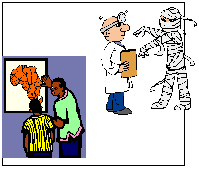
SPECIALIST WORKERS
- Rich countries can often send out experts or specialist workers like doctors, teachers, engineers and managers to help poor countries build up their own businesses and industries and help other people.
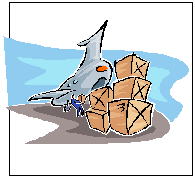
FOOD AID
- Rich countries sometimes have a lot more food than they need, and they can send things like wheat, corn, flour, powered milk and cheese to people in poor countries.
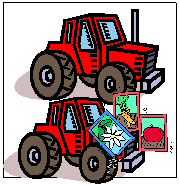
EQUIPMENT
- Special farming machinery like tractors and harvesters can be sent to poor countries, and machinery for use in factories can also be sent to build up industries.
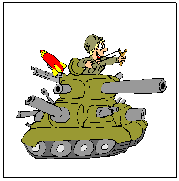
MILITARY AID
- If a friendly government is under attack from rebels, rich countries can help by sending tanks, guns and sometimes troops to help it stay in power.

EMERGENCY AID
- Sometimes we hear of disasters like earthquakes, floods and droughts in poor countries, and rich countries help by sending things like tents, food, clothing and medicines.
LONG TERM AID | SHORT TERM AID |
| SPECIALIST WORKERS EQUIPMENT MILITARY AID | MONEY AID FOOD AID EMERGENCY AID |
PROBLEM 4. LACK OF FOOD
One of the biggest problems facing the people of the Poor South is that they do not have enough food. According to scientists if we eat less than 2,200 calories a day, we are not getting enough food. A calorie is the amount of energy food gives us, for example, 125g of Greek yogurt provide us with 155kcal.


There are many reasons why countries do not have enough food. NATURAL DISASTERS such as earthquakes and floods sometimes affect how much food we have. Natural disasters can sometimes lead to FAMINE or DROUGHT.

Earthquake

Flood

Famine

Drought
Write your answers in the boxes!
- According to the scientist, what is the minimum number of calories per day a person needs to survive?
| The minimum number of calories a day a person needs to survive is 2,200 calories a day. |
- Study the table, and use it to complete the passage below:
Country | Daily Calorie Intake |
| United Kingdom | 3218 |
| India | 2204 |
| Nigeria | 2114 |
| Uganda | 2221 |
- I think the country least likely to experience a food shortage is the UK. My reason for choosing this country is has the highest daily calorie intake of 3218 calories per day
- The country most likely to experience food shortage is Nigeria. This is because it has the lowest daily calorie intake of 2114 calories per day.
viernes, 12 de noviembre de 2010
PROBLEM 3. WAR

Decide whether the following sentences are true or false:
- The most usual wars in developing countries are between different countries. FALSE
- Wars are really bad for a country because money is spent on weapons instead of being spent on necessary things. TRUE
SUDAN
1985-1995
ETHIOPIA
1974-1979
ANGOLA
1961-1995
1961-1995
MOZAMBIQUE
1981-1989
miércoles, 3 de noviembre de 2010
PROBLEMS FACING THE DEVELOPING WORLD
PROBLEM 1. POOR HEALTH
But not everyone who lives in the Poor South is poor. Some people live in comfortable houses, wear good clothes and eat good food. Some countries in the Middle East and Asia have their populations split into the very rich and the very poor. Other areas such as Africa have almost total poverty.
PROBLEM 1: HEALTH
Most people living in the developing world have very poor health. Life expectancy provides us with information about the health of a country. In Catalonia we have El Servei Català de Salut, which looks after our health. In the United Kingdom they have the National Health Service. As a result people in Catalunya or UK can expect to live 75 years on average, whereas countries like Sudan have a life expectancy of 53 years.
WHY DO PEOPLE IN DEVELOPING COUNTRIES HAVE POOR HEALTH?
Poor Sanitation: 2.9 billion people do not have safe sanitation facilities
No doctors: there is a shortage of doctors and nurses
No free medicines: people must pay for their medicines
No free health care: people must pay to see a doctor
There are 4 main reasons why people in developing countries have poor health. One is that there are poor sanitation facilities. For example, 2.9 billion people do not have things like clean drinking water. A second reason is that there is a shortage of doctors and nurses. Also, there is no free health care as people have to pay for their medicines.
United Kingdom | SUDAN | |
75 years | Life Expectancy | 52 years |
7 per 1000 babies born | Infant Mortality (How many babies die per 1000 born) | 107 per 1000 babies born |
1 Doctor: 710 patients | Doctor Patient Ratio (How many patients a doctor looks after) | 1 doctor: 11,110 patients |
I think UK. is the healthiest country because the table shows that people there live 75 years, whereas in Sudan, people live 52 years.
I think UK. is the healthiest country because the table shows 7 per 1000 babies born died whereas in Sudan 107 per 1000 babies born died.
I think UK. is the healthiest country because the table shows 1 doctor looks after 710 patients
whereas in Sudan 1 doctor looks after 11,110 patients.

PROBLEM 2. NO EDUCATION
Education is a very important part of people’s lives. In Catalonia and Scotland, for example, the Government thinks it is important to educate children free of charge. Being able to read and write is important because without education people cannot do many things in life, especially find a good job. In most developing countries parents must pay to send their children to school. Many people cannot afford to do this and this means that the majority of people are unable to read or write. Even when children in the developing world attend school, their schools are poorly equipped and there is usually a shortage of teachers. As a result, many developing countries have low rates of literacy.
Why are children in Catalonia and Scotland so lucky when it comes to education?
We are lucky because educationfree of charge.
Education is a very important part of people’s lives. In Catalonia and Scotland, for example, the Government thinks it is important to educate children free of charge. Being able to read and write is important because without education people cannot do many things in life, especially find a good job. In most developing countries parents must pay to send their children to school. Many people cannot afford to do this and this means that the majority of people are unable to read or write. Even when children in the developing world attend school, their schools are poorly equipped and there is usually a shortage of teachers. As a result, many developing countries have low rates of literacy.
Why are children in Catalonia and Scotland so lucky when it comes to education?
We are lucky because educationfree of charge.
Why is it important to be able to read and write? Because be able to read and write in order to find a good job.
Why are many children in the developing south unable to read and write?
Children on developing world are not able to read and write because
*Schools are poorly aquipped
*There is a short age of teacher
*Education is not free
Children on developing world are not able to read and write because
*Schools are poorly aquipped
*There is a short age of teacher
*Education is not free
Country | Literacy Levels Percentage of people who can read and write. |
| United Kingdom | 99% |
| Sudan | 27% |
| Rwanda | 59% |
Suscribirse a:
Entradas (Atom)