viernes, 26 de noviembre de 2010

miércoles, 24 de noviembre de 2010
LIVES THAT CHANGED OUR WORLD EXAMPLES OF INSPIRATIONAL PEOPLE
In this session we are going to have a look at the lives of some people that tried to improve their lives and the lives of the people in their communities and societies as they could not accept that people’s rights were being denied. We are going to focus on 3 men: MARTIN LUTHER KING, NELSON MANDELA and MOHANDAS GANDHI. But we should also mention the names of other people that wanted to change some aspects of the world like Mother Theresa, John Lennon, Dalai Lama, Rigoberta Menchú, etc.
 Martin Luther King (Atlanta USA 15 January 1929)
6 decades ago, in the southern USA, a young black boy called Martin Luther King was growing up. Martin saw how badly black Americans were treated by white Americans. Blacks could not attend the same schools, eat in the same restaurants or travel on the same buses as whites.
All over the south, Martin Luther King led peaceful protests, calling for equal rights for black people. In 1963 he led thousands of people, both black and white, on a march to Washington, the capital of the USA. In a speech he said: “Ï have a dream, that my four little children will be judged not by the colour of their skin, but by the content of their character”.

Nelson Mandela (Umtata, South-Africa, 18 July 1918)

Mohandas Ghandi (Porbandar India, 2 October 1869)

Mother Theresa (India, 26 August 1910)

Jhon Lenon (Liverpool, England, 9 October 1940)

Dalai Lama (Taktser, Qinghai, China 1935)

Rigoberta Menchu (Chimel, Guatemala 1959)

http://www.biographyonline.net/people/women-who-changed-world.html
 Martin Luther King (Atlanta USA 15 January 1929)
6 decades ago, in the southern USA, a young black boy called Martin Luther King was growing up. Martin saw how badly black Americans were treated by white Americans. Blacks could not attend the same schools, eat in the same restaurants or travel on the same buses as whites.
All over the south, Martin Luther King led peaceful protests, calling for equal rights for black people. In 1963 he led thousands of people, both black and white, on a march to Washington, the capital of the USA. In a speech he said: “Ï have a dream, that my four little children will be judged not by the colour of their skin, but by the content of their character”.
Martin Luther King had many enemies. In 1968 he was shot and killed by a white man. Although life for many black Americans has improved, they have still not gained complete equality, for which Martin Luther King fought so hard.

Nelson Mandela (Umtata, South-Africa, 18 July 1918)

Mohandas Ghandi (Porbandar India, 2 October 1869)

Mother Theresa (India, 26 August 1910)

Jhon Lenon (Liverpool, England, 9 October 1940)

Dalai Lama (Taktser, Qinghai, China 1935)

Rigoberta Menchu (Chimel, Guatemala 1959)
- Luther King, Mandela and Gandhi took action in different ways because they saw some human rights were being denied to some groups of people. Describe the denial of human rights in their 3 cases. Martin Luther King: Black Americans were badly treated by White Americans. Nelson Mandela: protested against the new “apartheid” laws in South Africa, which separated people because of the colour of their skin. Mohandas Ghandi:There were terrible fights between Hindu and Maslem people.
- How did they protest against what they thought was not right? (marches, demonstrations, etc) They protested pecefully.
- Did any of them go to prison? If so, how long were they there? Nelson Mandela was in prision for 28 years and Gandhi stayed in prison for 6 years or more.
- Are they all 3 still alive? If not, how did they die? Martin Luther King and Ghandi were murder abd Mandela is still alive.
- Do the problems that they wanted to solve still exist in society nowadays? Complete equality doesn't exist for everybody.
- Do you think they contributed to improving their communities? If so, in which way? Yes, because human rights were improved.
2. Cleopatra 69 -30 BC
The last Ptolemic ruler of Egypt. Cleopatra sought to defend Egypt from the expanding Roman Empire. In doing so she formed relationships with 2 of Rome’s most powerful leaders Marc Anthony and Julius Ceaser. These relationships have been depicted in Romantic terms, although in reality they may have been political alliances.http://www.biographyonline.net/people/women-who-changed-world.html
viernes, 19 de noviembre de 2010
SESSION 5:MILLENIUM CAMPAIGN: VOICES AGAINST POVERTY
MILLENIUM CAMPAIGN :
Traduction:
1. Erradicar la pobresa i la gana extremes.
2. Aconseguir enseñament d'educació primaria per tothom.
3. Distribuir igualtat de gènere i donar poder a les dones.
4. Reduir la mortalitat infantil.
5. Millorar la salud maternal.
6. Combatir HIV/AIDS, la malaria i altres malalties.
7. Assegurar la sostenibilitat del medi ambient.
8. Desenvolupar la complicitat global per al desenvolupament.
 |  |  |  |
 |  |  |  |
1. Erradicar la pobresa i la gana extremes.
2. Aconseguir enseñament d'educació primaria per tothom.
3. Distribuir igualtat de gènere i donar poder a les dones.
4. Reduir la mortalitat infantil.
5. Millorar la salud maternal.
6. Combatir HIV/AIDS, la malaria i altres malalties.
7. Assegurar la sostenibilitat del medi ambient.
8. Desenvolupar la complicitat global per al desenvolupament.
miércoles, 17 de noviembre de 2010
UNIT 5: HELPING DEVELOPING COUNTRIES
The People of the Rich North give AID to developing countries in order to help them deal with many of the problems that they face. There are different types of aid that can be given, some that will last for a long time (Long Term Aid) and others that will last for only a short period (short-term Aid). Look at the pictures below showing the main forms of aid given to the countries of the Poor South.



MONEY AID
- Many rich countries give loans to poor countries, but often they must be paid back. Sometimes grants are given; this money does not need to be paid back.
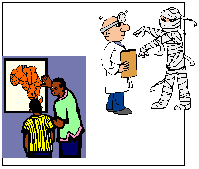
SPECIALIST WORKERS
- Rich countries can often send out experts or specialist workers like doctors, teachers, engineers and managers to help poor countries build up their own businesses and industries and help other people.
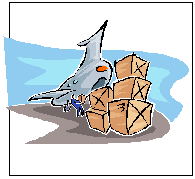
FOOD AID
- Rich countries sometimes have a lot more food than they need, and they can send things like wheat, corn, flour, powered milk and cheese to people in poor countries.
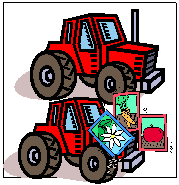
EQUIPMENT
- Special farming machinery like tractors and harvesters can be sent to poor countries, and machinery for use in factories can also be sent to build up industries.
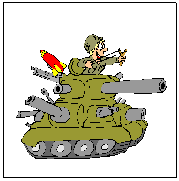
MILITARY AID
- If a friendly government is under attack from rebels, rich countries can help by sending tanks, guns and sometimes troops to help it stay in power.
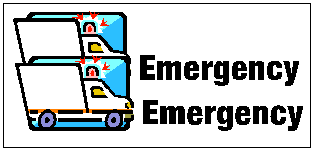
EMERGENCY AID
- Sometimes we hear of disasters like earthquakes, floods and droughts in poor countries, and rich countries help by sending things like tents, food, clothing and medicines.
LONG TERM AID | SHORT TERM AID |
| SPECIALIST WORKERS EQUIPMENT MILITARY AID | MONEY AID FOOD AID EMERGENCY AID |
PROBLEM 4. LACK OF FOOD
One of the biggest problems facing the people of the Poor South is that they do not have enough food. According to scientists if we eat less than 2,200 calories a day, we are not getting enough food. A calorie is the amount of energy food gives us, for example, 125g of Greek yogurt provide us with 155kcal.


There are many reasons why countries do not have enough food. NATURAL DISASTERS such as earthquakes and floods sometimes affect how much food we have. Natural disasters can sometimes lead to FAMINE or DROUGHT.

Earthquake

Flood

Famine

Drought
Write your answers in the boxes!
- According to the scientist, what is the minimum number of calories per day a person needs to survive?
| The minimum number of calories a day a person needs to survive is 2,200 calories a day. |
- Study the table, and use it to complete the passage below:
Country | Daily Calorie Intake |
| United Kingdom | 3218 |
| India | 2204 |
| Nigeria | 2114 |
| Uganda | 2221 |
- I think the country least likely to experience a food shortage is the UK. My reason for choosing this country is has the highest daily calorie intake of 3218 calories per day
- The country most likely to experience food shortage is Nigeria. This is because it has the lowest daily calorie intake of 2114 calories per day.
viernes, 12 de noviembre de 2010
PROBLEM 3. WAR

Decide whether the following sentences are true or false:
- The most usual wars in developing countries are between different countries. FALSE
- Wars are really bad for a country because money is spent on weapons instead of being spent on necessary things. TRUE
SUDAN
1985-1995
ETHIOPIA
1974-1979
ANGOLA
1961-1995
1961-1995
MOZAMBIQUE
1981-1989
miércoles, 3 de noviembre de 2010
PROBLEMS FACING THE DEVELOPING WORLD
PROBLEM 1. POOR HEALTH
But not everyone who lives in the Poor South is poor. Some people live in comfortable houses, wear good clothes and eat good food. Some countries in the Middle East and Asia have their populations split into the very rich and the very poor. Other areas such as Africa have almost total poverty.
PROBLEM 1: HEALTH
Most people living in the developing world have very poor health. Life expectancy provides us with information about the health of a country. In Catalonia we have El Servei Català de Salut, which looks after our health. In the United Kingdom they have the National Health Service. As a result people in Catalunya or UK can expect to live 75 years on average, whereas countries like Sudan have a life expectancy of 53 years.
WHY DO PEOPLE IN DEVELOPING COUNTRIES HAVE POOR HEALTH?
Poor Sanitation: 2.9 billion people do not have safe sanitation facilities
No doctors: there is a shortage of doctors and nurses
No free medicines: people must pay for their medicines
No free health care: people must pay to see a doctor
There are 4 main reasons why people in developing countries have poor health. One is that there are poor sanitation facilities. For example, 2.9 billion people do not have things like clean drinking water. A second reason is that there is a shortage of doctors and nurses. Also, there is no free health care as people have to pay for their medicines.
United Kingdom | SUDAN | |
75 years | Life Expectancy | 52 years |
7 per 1000 babies born | Infant Mortality (How many babies die per 1000 born) | 107 per 1000 babies born |
1 Doctor: 710 patients | Doctor Patient Ratio (How many patients a doctor looks after) | 1 doctor: 11,110 patients |
I think UK. is the healthiest country because the table shows that people there live 75 years, whereas in Sudan, people live 52 years.
I think UK. is the healthiest country because the table shows 7 per 1000 babies born died whereas in Sudan 107 per 1000 babies born died.
I think UK. is the healthiest country because the table shows 1 doctor looks after 710 patients
whereas in Sudan 1 doctor looks after 11,110 patients.

PROBLEM 2. NO EDUCATION
Education is a very important part of people’s lives. In Catalonia and Scotland, for example, the Government thinks it is important to educate children free of charge. Being able to read and write is important because without education people cannot do many things in life, especially find a good job. In most developing countries parents must pay to send their children to school. Many people cannot afford to do this and this means that the majority of people are unable to read or write. Even when children in the developing world attend school, their schools are poorly equipped and there is usually a shortage of teachers. As a result, many developing countries have low rates of literacy.
Why are children in Catalonia and Scotland so lucky when it comes to education?
We are lucky because educationfree of charge.
Education is a very important part of people’s lives. In Catalonia and Scotland, for example, the Government thinks it is important to educate children free of charge. Being able to read and write is important because without education people cannot do many things in life, especially find a good job. In most developing countries parents must pay to send their children to school. Many people cannot afford to do this and this means that the majority of people are unable to read or write. Even when children in the developing world attend school, their schools are poorly equipped and there is usually a shortage of teachers. As a result, many developing countries have low rates of literacy.
Why are children in Catalonia and Scotland so lucky when it comes to education?
We are lucky because educationfree of charge.
Why is it important to be able to read and write? Because be able to read and write in order to find a good job.
Why are many children in the developing south unable to read and write?
Children on developing world are not able to read and write because
*Schools are poorly aquipped
*There is a short age of teacher
*Education is not free
Children on developing world are not able to read and write because
*Schools are poorly aquipped
*There is a short age of teacher
*Education is not free
Country | Literacy Levels Percentage of people who can read and write. |
| United Kingdom | 99% |
| Sudan | 27% |
| Rwanda | 59% |
viernes, 29 de octubre de 2010
Life in Khalipathar vs. life in Sant Joan Despì
From 5:00-8:00 In SJD sleep between his hours and in Khalipathar girls work very much and the boys do excercise.
From 8:00-12:00 In SJD the boys and girls work in schools and in Khalipathar the boys and girls wash and bathe in the pond eat breakfast and go to school.
From 12:00-16:00 In SJD the boys and girls are in school and 14:00 lunch, in Khalipathar the boys and girls are in school and they eat at 13:00.
From 16:00-20:00 In SJD the boys and girls doing homework and extraschool activity, in Khalipathar the boys and girls play games the boys like cricket the most and the girls like skipping and at 19:30 we all pray to Goddess Saraswati.
From 20:00-21:00 In SJD the boys and girls dinner and watch tv and finally go sleep between 22:30-24:00.
From 8:00-12:00 In SJD the boys and girls work in schools and in Khalipathar the boys and girls wash and bathe in the pond eat breakfast and go to school.
From 12:00-16:00 In SJD the boys and girls are in school and 14:00 lunch, in Khalipathar the boys and girls are in school and they eat at 13:00.
From 16:00-20:00 In SJD the boys and girls doing homework and extraschool activity, in Khalipathar the boys and girls play games the boys like cricket the most and the girls like skipping and at 19:30 we all pray to Goddess Saraswati.
From 20:00-21:00 In SJD the boys and girls dinner and watch tv and finally go sleep between 22:30-24:00.
Country | Life expectancy | Infant mortality per 1000 | Daily food intake in calories | GNP ($) |
| USA | 76 | 9.7 | 3642 | 25,880 |
| NIGERIA | 49 | 121 | 2114 | 280 |
| SWEDEN | 78 | 5.8 | 3049 | 23,530 |
| UK | 76 | 9.5 | 3218 | 18,340 |
| JAPAN | 79 | 4.8 | 2858 | 34,630 |
| BRAZIL | 65 | 63 | 2643 | 2,970 |
| GERMANY | 77 | 7.5 | 3476 | 25,580 |
| INDIA | 58 | 95 | 2204 | 320 |
| MALAYSIA | 68 | 30 | 2723 | 3,480 |
| UGANDA | 49 | 107 | 2221 | 190 |
The five RICHER countries are:
- Japan.
- USA.
- Germany.
- Sweden.
- UK.
- Uganda.
- Nigera.
- India.
- Brazil.
- Malaysia.
Poor Countries have high Infant Mortality.
Rich Countries have high Daily Calorie Intake.
Poor Countries have a low GNP.
The USA is the RICHEST country in the world.
I agree because USA is a very big state, have much money and have high life expentacy.
miércoles, 27 de octubre de 2010
DIFFERENCES BETWEEN RICH AND POOR COUNTRIES
Country: País.
Life expentancy: Esperança de vida.
Infanty mortality per 1000: Mortalitat infantil per cada 1000.
Daily food intake in calories: La mitjana de consums d'aliments en calories.
GNP(Gross National Product): Producte Nacional Brut
Life expentancy: Esperança de vida.
Infanty mortality per 1000: Mortalitat infantil per cada 1000.
Daily food intake in calories: La mitjana de consums d'aliments en calories.
GNP(Gross National Product): Producte Nacional Brut
viernes, 22 de octubre de 2010
Rich people, Poor People

Translation to catalan:
Només quan l'últim arbre hagi mort i l'últim riu hagi estat enverinat i l'últim peix hagi estat atrapat ens adonarem que no podem menjar diners.

There are many divisions between the people of the world. One of the biggest is the difference between those who live in the RICH NORTH and the POOR SOUTH. The map below shows that the world can be divided into 2 parts: the Rich North and the Poor South.
Countries in the Rich North are also called DEVELOPED COUNTRIES. Examples of developed countries are: Spain, Great Britain, Germany, the USA, Japan and Australia.
A DEVELOPING COUNTRY is another name used to describe countries in the Poor South. Ethiopia, Mozambique, Brazil and India are all examples of developing countries.
The countries in the Poor South are also called LEDCs (Less economically developed countries) or Third World Countries. The North refers to richer countries, which are sometimes called the First World, MEDCs (More economically developed countries) or The West.
| RICH NORTH WORDS | POOR SOUTH WORDS |
| Developed countries | Developing countries |
| MEDCs | LEDCs |
| First World | Third World |
| The North | The South |
| COUNTRY | DEVELOPING COUNTRY | DEVELOPED COUNTRY |
| Catalonia (Barcelona) | X | |
| Cuba (La Habana) | X | |
| Scotland (Edimburgo) | X | |
| Sudan (Khartoum) | X | |
| USA (Washington) | X | |
| Germany (Berlin) | X | |
| Brazil (Brasília) | X | |
| Ethiopia (Addis Adheba) | X | |
| India (Nueva Delhi) | X | |
| New Zealand (Wellington) | X | |
| Colombia (Bogotá) | X | |
| Australia (Canberra) | X |
miércoles, 20 de octubre de 2010
THE RIGHTS OF THE CHILD
CHILD SOLDIERS: Recent estimates suggest that there are almost 300,000 child soldiers throughout the world fighting in over 40 conflicts. In countries such as Burma, Sudan and Afghanistan, children are fighting alongside adults in wars. Many child soldiers are forcibly removed from their homes, taken from their families and made to fight.
A. Child soldiers require less food than adult soldiers, so they are cheaper to feed. True
B. Child soldiers really want to fight and they go freely to the camps and follow orders without having to be given drugs. Fals
C. Children are more difficult to control than adults. Fals
D. Children are brainwashed and often given drugs. True
E. Modern weapons are very light and can be easily handled by children. True
DICTATION
STREET CHILDREN: Many children whose parents have died or no longer want to look after them are left to live on the streets. These children face serious health problems because of solvent abuse and attending school is not possible for them.
CHILD WORKERS: Throughout the world, children as young as 5 years old are forced to work. There are 250 million child workers between the ages of 5 and 14. Their work is often dangerous and is a form of slavery.

A. Child soldiers require less food than adult soldiers, so they are cheaper to feed. True
B. Child soldiers really want to fight and they go freely to the camps and follow orders without having to be given drugs. Fals
C. Children are more difficult to control than adults. Fals
D. Children are brainwashed and often given drugs. True
E. Modern weapons are very light and can be easily handled by children. True
DICTATION
STREET CHILDREN: Many children whose parents have died or no longer want to look after them are left to live on the streets. These children face serious health problems because of solvent abuse and attending school is not possible for them.
CHILD WORKERS: Throughout the world, children as young as 5 years old are forced to work. There are 250 million child workers between the ages of 5 and 14. Their work is often dangerous and is a form of slavery.

viernes, 15 de octubre de 2010
Rights and Responsibilities.
RIGHTS Responsibilities
-The right to an education. To attend school and do your homework every day.
-The right to own a pet. To look after & care four your pet.
-The raight to be a fairly. To act responsibly & treat others failry.
-The right to shelter. To treat and your house and the objects in it with respect
-The right to privacy. Not invade other people's privacy.
-The right to free speech. To remember that other people have different opinions.
-The right to play & be cared for. To care for people & to treat others the way you would expect to be treated.
-The right to an education. To attend school and do your homework every day.
-The right to own a pet. To look after & care four your pet.
-The raight to be a fairly. To act responsibly & treat others failry.
-The right to shelter. To treat and your house and the objects in it with respect
-The right to privacy. Not invade other people's privacy.
-The right to free speech. To remember that other people have different opinions.
-The right to play & be cared for. To care for people & to treat others the way you would expect to be treated.
Where are human rights no respected?
Art 1: In some countries in the world women are just allowed to go out in the company of their husbands.
Art 2: In the USA some decades ago black people could not get on the same bus where white people sitting, For example.
Art 4: Nowadays there are children slaves that make our sport shoes. In the past many black people from Africa became slaves.
Art 13: In some countries you must ask for permission to the governament to go out from your country ang go back again.
Art 2: In the USA some decades ago black people could not get on the same bus where white people sitting, For example.
Art 4: Nowadays there are children slaves that make our sport shoes. In the past many black people from Africa became slaves.
Art 13: In some countries you must ask for permission to the governament to go out from your country ang go back again.
miércoles, 13 de octubre de 2010
The Universal Declaration of Human Rights
Human rights are rights to which every human being should be entitled. According to the Universal Declaration of Human Rights, nobody should be made to live without these basic rights. It was written after the Second World War, when countries were determined not to have a repeat of the human atrocities carried out during the war. For example, the Holocaust, in which millions of Jews were killed.
http://www.un.org/Overview/rights.html
EXAMPLES:
Article1: All human beings are born free and equal in dignity and rights.They are endowed with reason and conscience and should act towards one another in a spirit of brotherhood.
Article 2: Everyone is entitled to all the rights and freedoms set forth in this Declaration, without distinction of any kind, such as race, colour, sex, language, religion, political or other opinion, national or social origin, property, birth or other status. Furthermore, no distinction shall be made on the basis of the political, jurisdictional or international status of the country or territory to which a person belongs, whether it be independent, trust, non-self-governing or under any other limitation of sovereignty.
Article 4: No one shall be held in slavery or servitude; slavery and the slave trade shall be prohibited in all their forms.
Resum en català: L'exclavitud esta prohibida i el comerç d'esclaus tambè.
Article 13:
(1) Everyone has the right to freedom of movement and residence within the borders of each state.
(2) Everyone has the right to leave any country, including his own, and to return to his country.
Resum en català: (1): Tothom te el dret de moviment i residencia.
(2): Tothom te el dret d'anars-e'n del pais i tornar-hi.
Article 18: Everyone has the right to freedom of thought, conscience and religion; this right includes freedom to change his religion or belief, and freedom, either alone or in community with others and in public or private, to manifest his religion or belief in teaching, practice, worship and observance.
Resum en català: Tothom te el dret d'escollir la seva religió i canviar-la
Article 24: Everyone has the right to rest and leisure, including reasonable limitation of working hours and periodic holidays with pay.
Resum en català: Tothom te el dret de descansar i pasars-ho bé, tenir unes hores estables i tenir vacances pagades.
Article 25:
(1) Everyone has the right to a standard of living adequate for the health and well-being of himself and of his family, including food, clothing, housing and medical care and necessary social services, and the right to security in the event of unemployment, sickness, disability, widowhood, old age or other lack of livelihood in circumstances beyond his control.
(2) Motherhood and childhood are entitled to special care and assistance. All children, whether born in or out of wedlock, shall enjoy the same social protection.
Resum en català: (1): Tothom te el dret de poder viure en bones condicions amb la seva familia, amb menjar, roba, i atenció mèdica i els serveis socials necessaris.
(2): Totes les mares i fills tenen que tenir una assistència especial. Tots el fills nascuts fora d'una familia te els mateixos drets que un que si.
Article 26:
(1) Everyone has the right to education. Education shall be free, at least in the elementary and fundamental stages. Elementary education shall be compulsory. Technical and professional education shall be made generally available and higher education shall be equally accessible to all on the basis of merit.
(2) Education shall be directed to the full development of the human personality and to the strengthening of respect for human rights and fundamental freedoms. It shall promote understanding, tolerance and friendship among all nations, racial or religious groups, and shall further the activities of the United Nations for the maintenance of peace.
(3) Parents have a prior right to choose the kind of education that shall be given to their children.
Resum en català: (1): L'educació te que ser gratis i obligatória.
(2): Tenen que educar als fills a racionar sobre els drets i la seva personalitat respecte altres persones.
(3): Els pares tenen la prioritat te deixar educar als seus fills.
http://www.un.org/Overview/rights.html
EXAMPLES:
Article1: All human beings are born free and equal in dignity and rights.They are endowed with reason and conscience and should act towards one another in a spirit of brotherhood.
Resum al català: Quan tots el humans neixem tenim la mateixa dignitat i drets qu qualsevol altre.Els humans tenim l'ùs de la raó i la consiència i som responsables dels nostres actes en l'esperit dels germans.
Article 2: Everyone is entitled to all the rights and freedoms set forth in this Declaration, without distinction of any kind, such as race, colour, sex, language, religion, political or other opinion, national or social origin, property, birth or other status. Furthermore, no distinction shall be made on the basis of the political, jurisdictional or international status of the country or territory to which a person belongs, whether it be independent, trust, non-self-governing or under any other limitation of sovereignty.
Resum al català: Tothom es igual encara que tinguin una raça diferent, un color diferent, un sexe diferent, un llenguatge diferent, una religio diferent, diferetns opinions, nacionalitat, propietat aniversari o d'altres estats.
Resum en català: L'exclavitud esta prohibida i el comerç d'esclaus tambè.
Article 13:
(1) Everyone has the right to freedom of movement and residence within the borders of each state.
(2) Everyone has the right to leave any country, including his own, and to return to his country.
Resum en català: (1): Tothom te el dret de moviment i residencia.
(2): Tothom te el dret d'anars-e'n del pais i tornar-hi.
Article 18: Everyone has the right to freedom of thought, conscience and religion; this right includes freedom to change his religion or belief, and freedom, either alone or in community with others and in public or private, to manifest his religion or belief in teaching, practice, worship and observance.
Resum en català: Tothom te el dret d'escollir la seva religió i canviar-la
Article 24: Everyone has the right to rest and leisure, including reasonable limitation of working hours and periodic holidays with pay.
Resum en català: Tothom te el dret de descansar i pasars-ho bé, tenir unes hores estables i tenir vacances pagades.
Article 25:
(1) Everyone has the right to a standard of living adequate for the health and well-being of himself and of his family, including food, clothing, housing and medical care and necessary social services, and the right to security in the event of unemployment, sickness, disability, widowhood, old age or other lack of livelihood in circumstances beyond his control.
(2) Motherhood and childhood are entitled to special care and assistance. All children, whether born in or out of wedlock, shall enjoy the same social protection.
Resum en català: (1): Tothom te el dret de poder viure en bones condicions amb la seva familia, amb menjar, roba, i atenció mèdica i els serveis socials necessaris.
(2): Totes les mares i fills tenen que tenir una assistència especial. Tots el fills nascuts fora d'una familia te els mateixos drets que un que si.
Article 26:
(1) Everyone has the right to education. Education shall be free, at least in the elementary and fundamental stages. Elementary education shall be compulsory. Technical and professional education shall be made generally available and higher education shall be equally accessible to all on the basis of merit.
(2) Education shall be directed to the full development of the human personality and to the strengthening of respect for human rights and fundamental freedoms. It shall promote understanding, tolerance and friendship among all nations, racial or religious groups, and shall further the activities of the United Nations for the maintenance of peace.
(3) Parents have a prior right to choose the kind of education that shall be given to their children.
Resum en català: (1): L'educació te que ser gratis i obligatória.
(2): Tenen que educar als fills a racionar sobre els drets i la seva personalitat respecte altres persones.
(3): Els pares tenen la prioritat te deixar educar als seus fills.
miércoles, 6 de octubre de 2010
Unit 2: Human rights
People in the world have many different legal rights. These rights are guaranteed under the law. However, in many parts of the world there are countries where basic rights simply do no exist.
To solve this problem the United Nations (UN) has agreed on a list of human rights with which we are going to deal with in the following activities.
UNITED NATIONS WEBSITE

Olive branches (for peace)
Continents (for where people live)
Globe (for world)
To solve this problem the United Nations (UN) has agreed on a list of human rights with which we are going to deal with in the following activities.
UNITED NATIONS WEBSITE

Olive branches (for peace)
Continents (for where people live)
Globe (for world)
- When did the United Nations come into existence? On 24 October 1945.
- What is the purpose of the United Nations? Is to bring all nations of the world together to work for peace and development.
- How many members are there in this organisation?There are currently 192 Members of the United Nations.
- Where is the Headquarters of the United Nations? Is in New York City but the land and buildings are international territory.
- What six official languages are used? Arabic, Chinese, English, French, Russian and Spanish.
- List the 4 aims of the United Nations:
- Together to work for peace and development.
- Based on the principles of justice.
- Human dignity.
- The well-being of all people.
viernes, 1 de octubre de 2010
My description
Hi, my name's Manel and my web name is kyodark. I'm 14 years old. I like many things. For example, blue color, videogames, all kinds of food, reading manga and other things. My mother tongue is Spanish but I speak English and Catalan. I don't practise any religion or pray or go to church. I was born in Hospitalet but I live in Sant Joan Despí . My mother was born in Sant Boi and my father was born in Valencia.


miércoles, 22 de septiembre de 2010
Sharyn's visit


Suscribirse a:
Entradas (Atom)